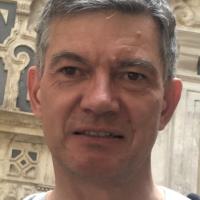
Bruno Blanke
Mes recherches se concentrent sur les courants et les échanges de masses d'eau opérés à l’échelle de la circulation générale océanique, ainsi que sur la dynamique des systèmes régionaux d'upwelling de bord est et leur sensibilité au couplage air-mer. J’ai mis au point et développé un outil diagnostique performant, ARIANE, disponible pour l’ensemble de la communauté scientifique et utilisé pour l'analyse de la dynamique océanique, sur la base de flotteurs numériques transportés par des champs de vitesse déduits de simulations numériques ou dérivés d'observations.
Bruno Blanke
Date of birth and marital status: May 22, 1964; married, three children.
Citizenship: French.
Present appointments:
• CNRS Senior Researcher in Physical Oceanography (2008-now)
Laboratoire d’Océanographie Physique et Spatiale (CNRS/LOPS), Brest, France;
• Assistant to the CNRS Directeur Scientifique Référent (ADSR) for the Sorbonne Université site (2021-now)
Direction d’Appui aux Partenariats Publics (CNRS/DAPP), Paris, France.
Former Appointments:
• 2016-2020: Scientific head of the Ocean-Atmosphere division at CNRS/INSU;
• 1997-2008: CNRS Researcher at the Laboratoire de Physique des Océans, Brest, France;
• 1994-1997: CNRS Researcher at the Laboratoire d’Océanographie Dynamique et de Climatologie (LODYC), Paris, France;
• 1992-1994: CNRS Research Scientist (CR) and UCLA Postdoctoral Associate, Department of Atmospheric Sciences, Los Angeles, California.
Qualifications:
• Accreditation to supervise research (HDR) from the Université de Bretagne Occidentale, Brest, France (2001);
• PhD from the Université Pierre et Marie Curie (Paris 6), Paris, France (1992);
• Engineering degree in Meteorology from the École Nationale de la Météorologie (1989);
• Engineering degree from the École Polytechnique (1987).
Education:
• 1989-1992: PhD in Physical Oceanography, at the Laboratoire d’Océanographie Dynamique et de Climatologie (Paris, France);
• 1987-1989: École Nationale de la Météorologie, Toulouse, France;
• 1984-1987: École Polytechnique, Palaiseau, France.
Scientific missions:
• 2010/07: Visiting Scientist at the universities of California Santa Cruz (UCSC) and Los Angeles (UCLA), California.
• 2006/07: Visiting Scientist at the Rosenstiel School of Marine and Atmospheric Science (RSMAS) of the University of Miami, Florida;
• 2003/10-2003/12: Visiting Scientist at the Department of Oceanography of UCT, South Africa;
• 2001/11-2002/07: Visiting Scientist at the Department of Oceanography of the University of Cape Town (UCT), South Africa;
Research interests:
• Lagrangian analysis of the circulation calculated by global and regional ocean models;
• Eastern-boundary upwelling systems;
• Coupling and transfer of properties between the coastal and open ocean;
• Large-scale variability of the Atlantic Ocean and the global ocean circulation.
Software development:
• Ariane: “Analyse lagrangienne de la dynamique de modèles numériques de circulation océanique”
CeCILL license; constant developments and updates; training courses;
• Participation in the development of the Ichthyop and Waters models.
Recent (<10 yr) administrative and technical responsibilities:
• Lead of Subcommittee 6 – Earth and Universe Sciences, Expert Panel for the Protection of the Nation’s Scientific and Technical Assets (PPST) (2025-now);
• CNRS co-pilot of the Océan & Climat Programme Prioritaire de Recherche (2024-now);
• Special advisor to the CNRS Deputy director for science on CNRS key figures and indicators (2023);
• Chairman of the Observatoire de Versailles-Saint-Quentin-en-Yvelines (OVSQ) board (2022-now);
• Chairman of the Institut Universitaire Européen de la Mer (IUEM) internal scientific council (2022-now);
• Scientific head of the Ocean Atmosphere division at CNRS/INSU, from March 2016 to December 2020;
• Member of the TOSCA committee (evaluation of CNES-fundable proposals), from 2007 to 2014;
• Joint management of the Laboratoire de Physique des Océans (2008-2011 term and 2012-2013 half term.
Teaching:
Training in the ARIANE Lagrangian analysis tool (lectures).
Projects, partnership and valorization:
Research studies led in partnership with CNES, Ifremer, IRSN and SHOM.
Communication and public awareness
• “Voyage au centre de la mer”, a documentary film about ocean currents, directed by Marc Jampolsky and coproduced by Arte, showcased at the 2013 Pariscience international science film festival (3-8 Oct. 2013; invited speaker).
Note: The genesis of this film and its framework rely heavily on my scientific work on the Lagrangian description of the global ocean circulation, with especially an animation that was used in several scientific events: “Océan et Climat” at the Cité des sciences et de l’industrie (Spring 2011), CNRS/sagascience multimedia package about the climate system (Fall 2010), etc.
Complete list of Bruno Blanke's Tier 1 publications
ARIANE-related work is in bold italic.
Studies targeting the regional scales of the eastern margins are in green.
Studies dealing with the fate of plastics in the oceans are in red.
The work of supervised interns, doctoral students and post-doctoral fellows is highlighted.
Before 2000:
- Blanke, 1992: Couche de mélange dans un modèle tropical de circulation générale océanique.
- Blanke and Delecluse, 1993: Variability of the tropical Atlantic Ocean simulated by a general circulation model with two different mixed-layer physics. Journal of Physical Oceanography, https://doi.org/10.1175/1520-0485(1993)023<1363:VOTTAO>2.0.CO;2
- Waliser et al., 1994: Shortwave feedbacks and El Niño-Southern Oscillation: Forced ocean and coupled ocean-atmosphere experiments. Journal of Geophysical Research Oceans, https://doi.org/10.1029/94JC02297
- Blanke et al., 1997: Estimating the effect of stochastic wind stress forcing on ENSO irregularity. Journal of Physical Oceanography, https://doi.org/10.1175/1520-0442(1997)010<1473:ETEOSW>2.0.CO;2
- Blanke and Raynaud, 1997: Kinematics of the Pacific Equatorial Undercurrent: a Eulerian and Lagrangian approach from GCM results. Journal of Physical Oceanography, https://doi.org/10.1175/1520-0485(1997)027%3C1038:KOTPEU%3E2.0.CO;2. Work from a research internship I supervised
- Blanke et al., 1999: Warm water paths in the equatorial Atlantic as diagnosed with a general circulation model. Journal of Physical Oceanography, https://doi.org/10.1175/1520-0485(1999)029%3C2753:WWPITE%3E2.0.CO;2. Work from a research internship I supervised
Between 2000 and 2009:
- Blanke et al., 2001: A global diagnostic of interocean mass transfers. Journal of Physical Oceanography, https://doi.org/10.1175/1520-0485(2001)031%3C1623:AGDOIM%3E2.0.CO;2
- Speich et al., 2001: Warm and cold water paths of a GCM thermohaline conveyor belt. Geophysical Research Letters, https://doi.org/10.1029/2000GL011748
- Blanke et al., 2002: Linking wind and upwelling interannual variability in a regional model of the southern Benguela. Geophysical Research Letters, https://doi.org/10.1029/2002GL015718. Work from a research internship I supervised
- Blanke et al., 2002: A Lagrangian numerical investigation of the origins and fates of the salinity maximum water in the Atlantic. Journal of Geophysical Research Oceans, https://doi.org/10.1029/2002JC001318. Work from a research internship I supervised
- Blanke et al., 2002: Diagnosing and picturing the North Atlantic segment of the global conveyor belt by means of an ocean general circulation model. Journal of Physical Oceanography, https://doi.org/10.1175/1520-0485(2002)032%3C1430:DAPTNA%3E2.0.CO;2. Work from a research internship I supervised
- Blanke et al., 2002: A global diagnostic of interior ocean ventilation. Geophysical Research Letters, https://doi.org/10.1029/2002GL015635
- Izumo et al., 2002: Tropical pathways, equatorial undercurrent variability and the 1998 La Niña. Geophysical Research Letters, https://doi.org/10.1029/2002GL015073. Thesis work I co-supervised
- Speich et al., 2002: Tasman leakage: a new route in the global ocean conveyor belt. Geophysical Research Letters, https://doi.org/10.1029/2001GL014586
- Rodgers et al., 2003: Extratropical sources of equatorial Pacific upwelling in an OGCM. Geophysical Research Letters, https://doi.org/10.1029/2002GL016003
- Rodgers et al., 2004: Radiocarbon as a thermocline proxy for the eastern equatorial Pacific. Geophysical Research Letters, https://doi.org/10.1029/2004GL019764
- Valdivieso da Costa and Blanke, 2004: Lagrangian methods for flow climatologies and trajectory error assessment. Ocean Modelling, https://doi.org/10.1016/S1463-5003(03)00023-4. Postdoctoral work I supervised
- Blanke et al., 2005: Modeling the structure and variability of the southern Benguela upwelling using QuikSCAT wind forcing. Journal of Geophysical Research Oceans, https://doi.org/10.1029/2004JC002529. Work from a research internship I supervised
- Friocourt et al., 2005: Water mass export from Drake Passage to the Atlantic, Indian and Pacific Oceans: A Lagrangian model analysis. Journal of Physical Oceanography, https://doi.org/10.1175/JPO2748.1. Work from a research internship I supervised
- Radenac et al., 2005: Displacements and transformations of nitrate-rich and nitrate-poor water masses in the tropical Pacific during the 1997 El Niño. Ocean Dynamics, https://doi.org/10.1007/s10236-005-0111-5
- Blanke et al., 2006: Salinity changes along the upper limb of the Atlantic thermohaline circulation. Geophysical Research Letters, https://doi.org/10.1029/2005GL024938
- Doglioli et al., 2006: A Lagrangian analysis of the Indian-Atlantic interocean exchange in a regional model. Geophysical Research Letters, https://doi.org/10.1029/2006GL026498. Postdoctoral work I have supervised
- Speich et al., 2006: The role of bathymetry in Agulhas Current configuration and behaviour. Geophysical Research Letters, https://doi.org/10.1029/2006GL027157
- Doglioli et al., 2007: Tracking coherent structures in a regional ocean model with wavelet analysis: Application to Cape Basin eddies. Journal of Geophysical Research Oceans, https://doi.org/10.1029/2006JC003952. Postdoctoral work I have supervised
- Durand et al., 2007: Modeling the barrier-layer formation in the South-Eastern Arabian Sea. Journal of Climate, https://doi.org/10.1175/JCLI4112.1
- Friocourt et al., 2007: A regional numerical ocean model of the circulation in the Bay of Biscay. Journal of Geophysical Research Oceans, https://doi.org/10.1029/2006JC003935. Thesis work I supervised
- Muller et al., 2007: High resolution atmospheric forcing for regional oceanic model: The Iroise Sea. Ocean Dynamics, https://doi.org/10.1007/s10236-007-0115-4. Thesis work I supervised
- Pizzigalli et al., 2007: Seasonal Probability Dispersion Maps in the Mediterranean Sea obtained from the MFS Eulerian velocity fields. Journal of Geophysical Research Oceans, https://doi.org/10.1029/2006JC003870
- Speich et al., 2007: Atlantic meridional overturning circulation and the Southern Hemisphere supergyre. Geophysical Research Letters, https://doi.org/10.1029/2007GL031583
- Dutrieux et al., 2008: Lagrangian study of tropical instability vortices in the Atlantic. Journal of Physical Oceanography, https://doi.org/10.1175/2007JPO3763.1
- Friocourt et al., 2008: On the Dynamics of the Slope Current System along the West European Margin. Part I: Analytical Calculations and Numerical Simulations with Steady-State Forcing. Journal of Physical Oceanography, https://doi.org/10.1175/2008JPO3744.1. Thesis work I supervised
- Friocourt et al., 2008: On the Dynamics of the Slope Current System along the West European Margin. Part II: Analytical Calculations and Numerical Simulations with Seasonal Forcing. Journal of Physical Oceanography, https://doi.org/10.1175/2008JPO3745.1. Thesis work I supervised
- Iudicone et al., 2008: The role of Southern Ocean surface forcings and mixing in the global conveyor. Journal of Physical Oceanography, https://doi.org/10.1175/2008JPO3519.1
- Iudicone et al., 2008: The global conveyor belt from a Southern Ocean perspective. Journal of Physical Oceanography, https://doi.org/10.1175/2007JPO3525.1
- Koch-Larrouy et al., 2008: Water mass transformation along the Indonesian throughflow in an OGCM. Ocean Dynamics, https://doi.org/10.1007/s10236-008-0155-4
- Lett et al., 2008: A Lagrangian tool for modelling ichthyoplankton dynamics. Environmental Modelling & Software, https://doi.org/10.1016/j.envsoft.2008.02.005. Engineering contract work I co-supervised
- Blanke et al., 2009: Ocean variability over the Agulhas Bank and its dynamical connection with the southern Benguela upwelling system. Journal of Geophysical Research Oceans, https://doi.org/10.1029/2009JC005358. Work from a research internship I supervised
- Bonhommeau et al., 2009: How fast can the European eel (Anguilla anguilla) larvae cross the Atlantic Ocean? Fisheries Oceanography, https://doi.org/10.1111/j.1365-2419.2009.00517.x
- Bonhommeau et al., 2009: Estimates of the mortality and the duration of the trans-Atlantic migration of European eel Anguilla anguilla leptocephali using a particle tracking model. Fisheries Oceanography, https://doi.org/10.1111/j.1095-8649.2009.02298.x
- Muller et al., 2009: Estimating the Lagrangian residual circulation in the Iroise Sea. Journal of Marine Systems, https://doi.org/10.1016/j.jmarsys.2009.01.008. Thesis work I supervised
- Rubio et al., 2009: Mesoscale eddy activity in the southern Benguela upwelling system from satellite altimetry and model data. Progress in Oceanography, https://doi.org/10.1016/j.pocean.2009.07.029. Postdoctoral work I supervised
Between 2010 and 2019:
- Lique et al., 2010: On the origins of water masses exported along both sides of Greenland: A Lagrangian Model Analysis. Journal of Geophysical Research Oceans, https://doi.org/10.1029/2009JC005316
- Muller et al., 2010: Identification of typical scenarios for the surface Lagrangian residual circulation in the Iroise Sea. Journal of Geophysical Research Oceans, https://doi.org/10.1029/2009JC005834. Thesis work I supervised
- Ollitrault et al., 2010: Estimating the wreckage location of the Rio-Paris af447. Report from Drift Group to Bureau Enquêtes Accidents
- Grenier et al., 2011: From the western boundary currents to the Pacific Equatorial Undercurrent: Modeled pathways and water mass evolutions. Journal of Geophysical Research Oceans, https://doi.org/10.1029/2011JC007477
- Montes et al., 2011: Subsurface connections in the eastern tropical Pacific during La Niña 1999-2001 and El Niño 2002-2003. Journal of Geophysical Research Oceans, https://doi.org/10.1029/2011JC00762> Work from a research internship I co-supervised
- Blanke et al., 2012: Sensitivity of advective transfer times across the North Atlantic Ocean to the temporal and spatial resolution of model velocity data: Implication for European eel larval transport. Dynamics of Atmospheres and Oceans, https://doi.org/10.1016/j.dynatmoce.2012.04.003
- Chenillat et al., 2012: North Pacific Gyre Oscillation modulates seasonal timing and ecosystem functioning in the California Current upwelling system. Geophysical Research Letters, https://doi.org/10.1029/2012GL053111. Thesis work I supervised
- Rimaud et al., 2012: The exchange of Intermediate Water in the southeast Atlantic: Water mass transformations diagnosed from the Lagrangian analysis of a regional ocean model. Journal of Geophysical Research Oceans, https://doi.org/10.1029/2012JC008059. Work from a research internship I co-supervised
- Bentamy et al., 2013: Improvement in air−sea fluxes derived from satellite observations. International Journal of Remote Sensing, https://doi.org/10.1080/01431161.2013.787502
- Chenillat et al., 2013: California coastal upwelling onset variability: cross-shore and bottom-up propagation in the planktonic ecosystem. PLOS ONE, https://doi.org/10.1371/journal.pone.0062281. Thesis work I supervised
- Bennis et al., 2014: Mixing parameterization: Impacts on rip currents and wave set-up. Ocean Engineering, https://doi.org/10.1016/j.oceaneng.2014.04.021. Postdoctoral work I supervised
- De Boyer Montégut et al., 2014: Role of fronts in the formation of Arabian Sea barrier layers during summer monsoon. Ocean Dynamics, https://doi.org/10.1007/s10236-014-0716-7
- Desbiolles et al., 2014: Origin of fine-scale wind stress curl structures in the Benguela and Canary upwelling systems. Journal of Climate, https://doi.org/10.1002/2014JC010015. Thesis work I supervised
- Desbiolles et al., 2014: Short-term upwelling events at the western African coast related to synoptic atmospheric structures as derived from satellite observations. Journal of Climate, https://doi.org/10.1002/2013JC009278. Thesis work I supervised
- Blanke et al., 2015: Lagrangian water mass tracing from pseudo-Argo, model-derived salinity, tracer and velocity data: An application to Antarctic Intermediate Water in the South Atlantic Ocean. Ocean Modelling, https://doi.org/10.1016/j.ocemod.2014.11.004. Postdoctoral work I co-supervised
- Chenillat et al., 2015: Quantifying tracer dynamics in moving fluids: a combined Eulerian-Lagrangian approach. Frontiers in Environmental Science, https://doi.org/10.3389/fenvs.2015.00043
- Chenillat et al., 2015: Plankton dynamics in a cyclonic eddy in the Southern California Current System. Journal of Climate, https://doi.org/10.1002/2015JC010826
- Maes et al., 2015: Tracking the origins of plastic debris across the Coral Sea: A case study from the Ouvéa Island, New Caledonia. Marine Pollution Bulletin, https://doi.org/10.1016/j.marpolbul.2015.06.022
- Thomas et al., 2015: A Lagrangian method to isolate the impacts of mixed layer subduction on the meridional overturning circulation in a numerical model. Journal of Climate, https://doi.org/10.1175/JCLI-D-14-00631.1. Postdoctoral work I co-supervised
- Villar et al., 2015: Environmental characteristics of Agulhas rings affect inter-ocean plankton transport. Science, https://doi.org/10.1126/science.1261447
- Bennis et al., 2016: Modulation of wave-current interactions by horizontal mixing and spatial resolution. Ocean Modelling, https://doi.org/10.1016/j.ocemod.2015.12.005. Postdoctoral work I supervised
- Desbiolles et al., 2016: Response of the Southern Benguela upwelling system to fine-scale modifications of the coastal wind. Journal of Marine Systems, https://doi.org/10.1016/j.jmarsys.2015.12.002. Thesis work I supervised
- Maes et al., 2016: Origin and fate of surface drift in the oceanic convergence zones of the eastern Pacific. Journal of Climate, https://doi.org/10.1002/2016GL068217
- Rousselet et al., 2016: Impacts of mesoscale activity on the water masses and circulation in the Coral Sea. Journal of Climate, https://doi.org/10.1002/2016JC011861
- Desbiolles et al., 2017: Two decades |LS|1992-2012|RS| of surface wind analyses based on satellite scatterometer observations. Journal of Marine Systems, https://doi.org/10.1016/j.jmarsys.2017.01.003. Postdoctoral work I co-supervised
- Toyama et al., 2017: Large re-emergence of anthropogenic carbon into the ocean's surface mixed layer sustained by the ocean's overturning circulation. Journal of Climate, https://doi.org/10.1175/JCLI-D-16-0725.1
- Capuano et al., 2018: Mesoscale and submesoscale processes in the southeast Atlantic and their impact on the regional thermohaline structure. Journal of Climate, https://doi.org/10.1002/2017JC013396
- Chenillat et al., 2018: Eddy properties in the Southern California Current system. Ocean Dynamics, https://doi.org/10.1007/s10236-018-1158-4
- Laxenaire et al., 2018: Anticyclonic Eddies Connecting the Western Boundaries of Indian and Atlantic Oceans. Journal of Geophysical Research Oceans, https://doi.org/10.1029/2018JC014270. Work from a research internship I co-supervised
- Maes et al., 2018: A surface “superconvergent” pathway connecting the South Indian Ocean to the subtropical South Pacific Gyre. Journal of Climate, https://doi.org/10.1002/2017GL076366. Work from a research internship I co-supervised
- Rousselet et al., 2018: Large- to submesoscale surface circulation and its implications on biogeochemical/biological horizontal distributions during the OUTPACE cruise (southwest Pacific). Biogeosciences, https://doi.org/10.5194/bg-15-2411-2018
- Van Sebille et al., 2018: Lagrangian ocean analysis: fundamentals and practices. Ocean Modelling, https://doi.org/10.1016/j.ocemod.2017.11.008
- Dobler et al., 2019: Large impact of Stokes drift on the fate of surface floating debris in the South Indian Basin. Marine Pollution Bulletin, https://doi.org/10.1016/j.marpolbul.2019.07.057. Work from a research internship I co-supervised
Since 2020:
- Ishii et al., 2020: Ocean acidification from below in the tropical Pacific. Global Biogeochemical Cycles, https://doi.org/10.1029/2019GB006368
- Chenillat et al., 2021: Fate of floating plastic debris released along the coasts in a global ocean model. Marine Pollution Bulletin, https://doi.org/10.1016/j.marpolbul.2021.112116. Postdoctoral work I co-supervised
- Bajon et al., 2023: Influence of waves on the three-dimensional distribution of plastic in the ocean. Marine Pollution Bulletin, https://doi.org/10.1016/j.marpolbul.2022.114533. Work from a research internship I co-supervised
- Hariri et al., 2023: Sensitivity of gyrescale marine connectivity estimates to fine-scale circulation. Ocean Science, https://doi.org/10.5194/os-19-1183-2023. Postdoctoral work I co-supervised
- Oulhen et al., 2023: Reconstructing the ocean state using Argo data and a data-driven method. Journal of Atmopsheric and Oceanic Technology, https://doi.org/10.1175/JTECH-D-23-0157.1. Thesis work under my formal supervision
- Lévy et al., 2025: The 2025 Starfish Barometer. State of the Planet, https://doi.org/10.5194/sp-6-osr9-1-2025.
- Oulhen et al., 2025: Reconstructing monthly 20th century salinity fields using a data-driven method and Argo data. Ocean Dynamics, https://doi.org/10.1007/s10236-025-01690-7. Thesis work under my formal supervision
Mon implication dans l’enseignement concerne la formation à l’outil ARIANE, plusieurs fois par an, pour des chercheurs individuels ou des groupes, avec le programme type suivant : accueil au LOPS, démarche d’analyse, fonctionnalités de l’outil, concepts numériques, mise en application (avec Nicolas GRIMA, ingénieur de recherche au CNRS), interprétation de premiers résultats. Cette formation dispose désormais d’un ensemble de vidéos, grâce à une interaction avec le service audiovisuel de l’UBO.