
Webinaire SEA-EU
Qu'est-ce qu'un module virtuel SEA-EU ?
Les modules virtuels SEA-EU (SEA-EU Virtual Modules) sont proposés par les universités de l'Alliance. Ces cours offrent aux étudiant·es de Master des opportunités de mobilités en ligne et un apprentissage international dans diverses disciplines liées :
- Aux sciences de la mer et du littoral (en collaboration avec l'école doctorale iMSMS de l'Université de Kiel).
- Aux sciences économiques.
Les cours sont dispensés en anglais par des enseignant·es des universités partenaires. En participant à ces modules, vous aurez l'opportunité de collaborer avec des experts de différents domaines de recherche et d'échanger avec des étudiant·es de toute l'Europe.
Pourquoi participer à un module virtuel SEA-EU ?
- Internationalisez vos études sans voyager
- Explorez différentes thématiques, trouvez le module virtuel qui correspond à votre domaine de prédilection
- Bénéficiez de la diversité culturelle et de l’ouverture d’esprit qu’offre un apprentissage international.
Les conditions d'inscription :
- Vous devez faire votre inscription avec votre adresse email étudiant UBO
- Un certificat de participation avec les ECTS vous sera fournit à la suite de votre participation au module, et si vous l'avez validé.
- Les ECTS acquis sont surnuméraires et n'entrent pas dans le calcul de votre moyenne.
- Une fois inscrit·e, la participation au module devient obligatoire, et vous vous engagez à y assister
Metal Contaminants – Metals in the Ocean
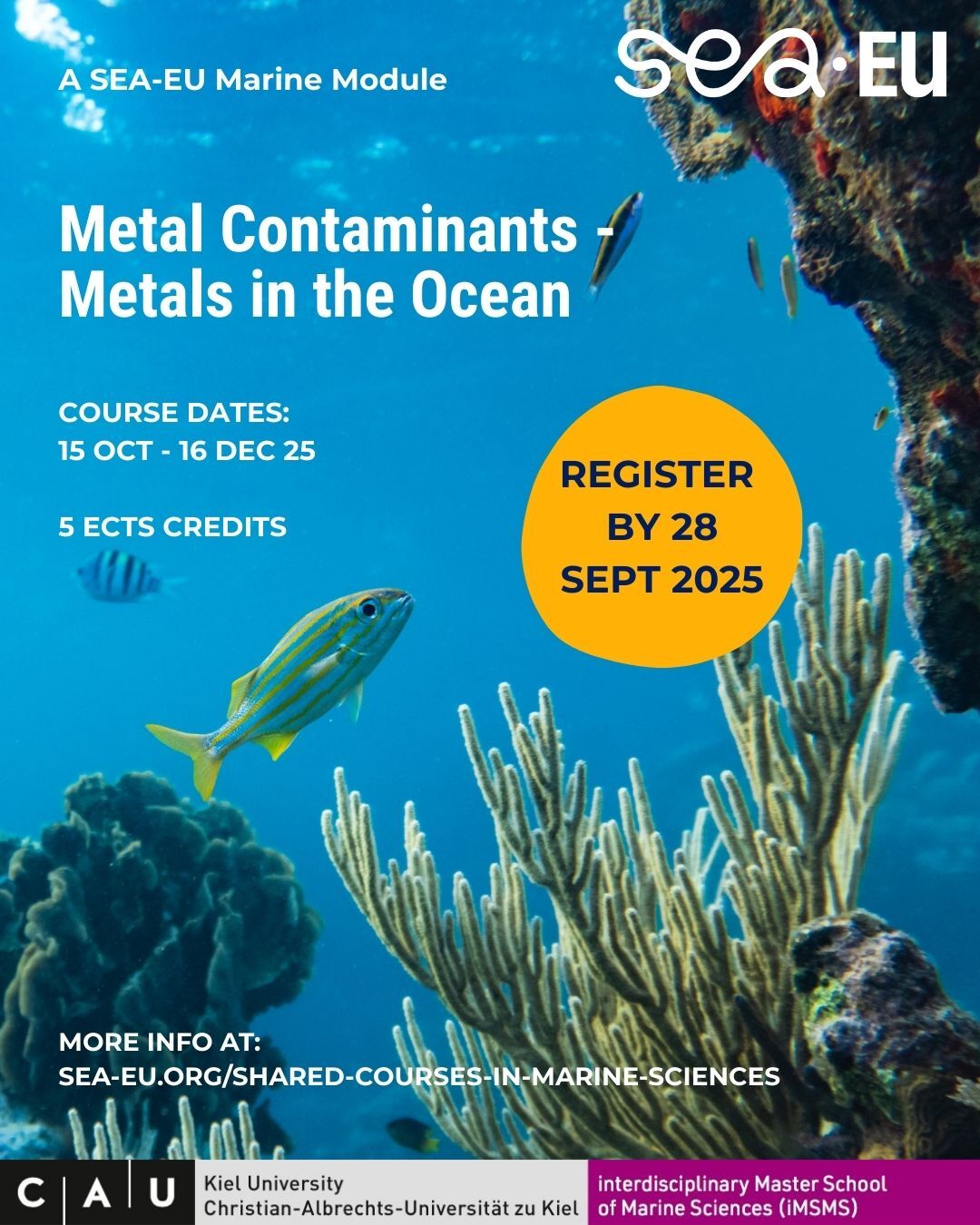
Interdisciplinary course on heavy metal contaminants in the marine environment.
Students will study the transport, fate, and speciation of metals, alongside bioavailability, bioaccumulation, and detoxification mechanisms. The curriculum emphasises evaluating biotic responses to metal exposure, utilising biomarkers, and conducting risk assessments through environmental toxicology principles. A key focus is on the impact of current and future ocean activities, such as deep- sea mining and ocean alkalinity enhancement, on metal contamination. Students will analyse these activities' environmental implications and explore potential solutions. The course also covers the scientific, technological, societal, and economic aspects of ocean interventions, integrating natural sciences with economics, biotechnology, ethics, policy, and ocean governance. Case studies will provide practical insights into contemporary marine ecotoxicology applications.
Dates : 14 October - 16 December 2025.
Delivery : a blend of hybrid & online lectures and hybrid applied learning exercises by international experts. 5 ECTS / 35 contact hours + 125 hours independent study from September to January.
Deadline to apply : 28th September 2025. Apply here.