Digital city and public lighting
The second axis is focusing on the public lightning’s role in a critical perspective of the so-called “Smart” territory, especially with regard to the use of digital technology in connection with the lightning network.
Thanks to technological development, controllers and communication systems are more and more accessible and used in the conception of smart cities. The same applies to public lightning and its study is essential for a better understanding of its impact on human behavior.
Introducing our research projects
Many scientific articles have already attempted to analyze the relationship between different lighting parameters and the feeling of safety, such as temperature and color or street characteristics. We are therefore seeking to explore this link as well as digital solutions allowing, on the one hand, energy savings and, on the other, the measurement of the impact of artificial light on biodiversity
In recent decades, urban nightscapes have become associated with over-lighting, which has become the norm. It can be said that lighting systems play a major role in city life (feeling safe, development of a night-time economy and various nocturnal practices). But the imperatives of reducing energy consumption and protecting biodiversity must be taken into account when designing public lighting, without compromising the feeling of safety.
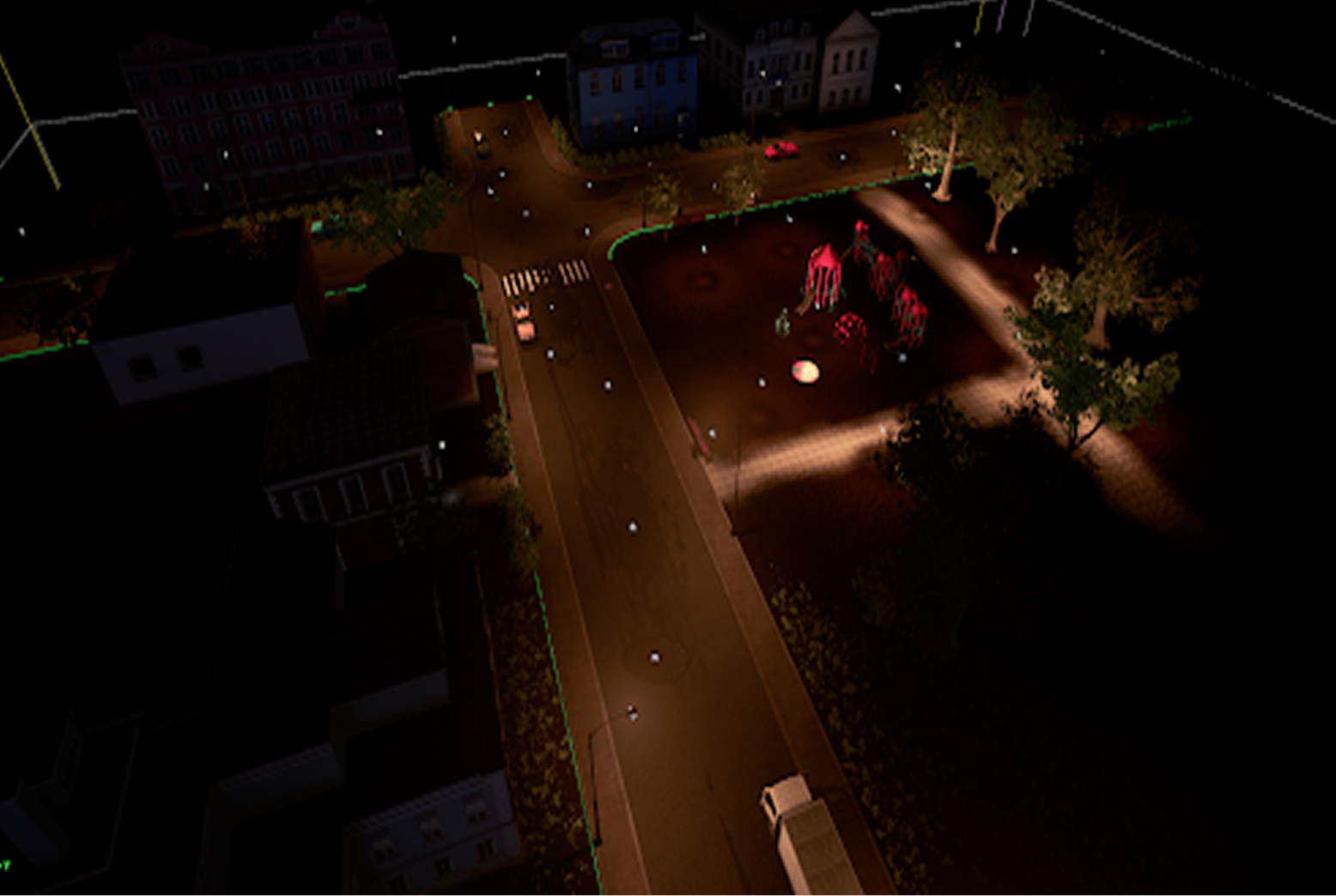
We propose an exploratory approach to using virtual reality to test different lighting intensities in order to study their impact on pedestrians' sense of safety. Virtual Reality has become the focal point of this axis, thanks to the support of tutored projects within Lab STICC and ENIB, which have enabled us to improve, test and demonstrate a digital model of public lighting. Another project will also be launched, focusing on embedded systems.
VR SIMULATIONS OF PUBLIC LIGHTING
Virtual reality offers versatility allowing to modify and analyze some environmental parameters such as light intensity, color, etc.
PDS & LIGHTING SWITCH
The Pedestrian Detection System (PDS) quickly and reliably determines the presence of a pedestrian from one or more cameras.
SKY GLOW
We combine tools and approaches to characterize and analyze light pollution as seen from the ground and the impact of nighttime sky glows.
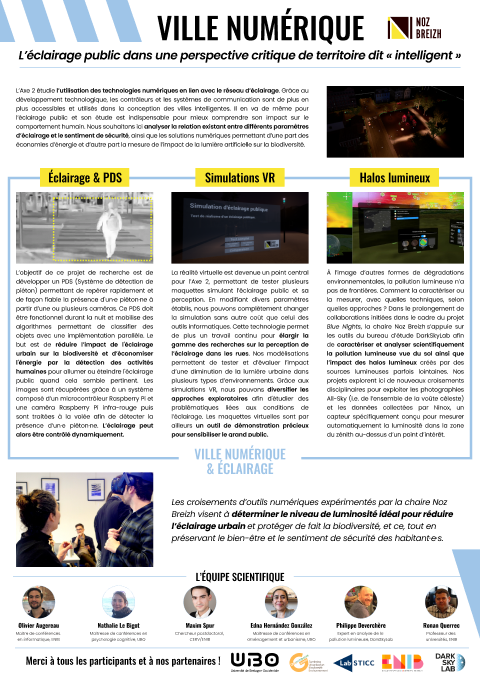
By crossing digital tools, the Noz Breizh chair aims to determine the ideal level of brightness to reduce urban lighting and thereby protect biodiversity, while ensuring residents’ well-being and sense of safety.
Citation du poster : Chaire Noz Breizh (2025), L’éclairage public dans une perspective critique de territoire dit « intelligent », présenté dans le cadre du colloque Noz Breizh, Brest, 20 mars - 15 mai 2025