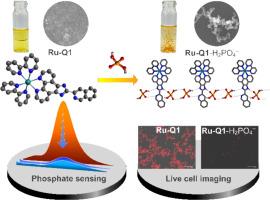
Selective luminescent recognition of biologically relevant phosphate ions using imidazo-phenanthroline functionalized ruthenium(II) probe. Heena, S. Singh, R. Dubey, F. Thetiot, Sangetaa, B. Guchhait, N. Medda, P. Roy, S. Layek, T. Goswami, S. Kumar, Inorganic Chemistry Communications 2026, 184, 116000, DOI: 10.1016/j.inoche.2025.116000
Ruthenium(II)-polypyridyl metalloreceptor Ru-Q1, featuring integrated anion-binding functionalities, has been systematically evaluated for its anion sensing ability. Among various analytes, Ru-Q1 exhibited high selectivity and sensitivity towards biogenic phosphate ions (H2PO4− and HP2O73−), showing pronounced luminescence quenching and bathochromic shifts. Photoluminescence titrations revealed low detection limits of 0.813 μM for H2PO4− and 0.6 μM for HP2O73−, respectively, with binding constants of 8.5 × 10⁴ M−1 and 4.5 × 10⁵ M−1. Competitive ion studies confirmed the excellent selectivity of Ru-Q1, even in the presence of potentially interfering metal ions. Mechanistic insights were gained through Job's plot analysis, 1H NMR titration, FE-SEM, emission lifetime studies, and DFT calculations. The probe's applicability in biological contexts was demonstrated via luminescence imaging in HepG2 cells. Preliminary data also indicate potential antimicrobial activity, highlighting the need for in-depth investigation.
Partenaires
